Brumble Bee FarmsBy The Institute for Applied Ontological Mathematics.
Temperature
How the colony regulates brood and cluster conditions.
Open Hive Research Network
We collect and analyze continuous biological and environmental data from honey bee hives, building and testing connected systems that turn those records into practical decision support for beekeepers.
501(c)(3) nonprofit research
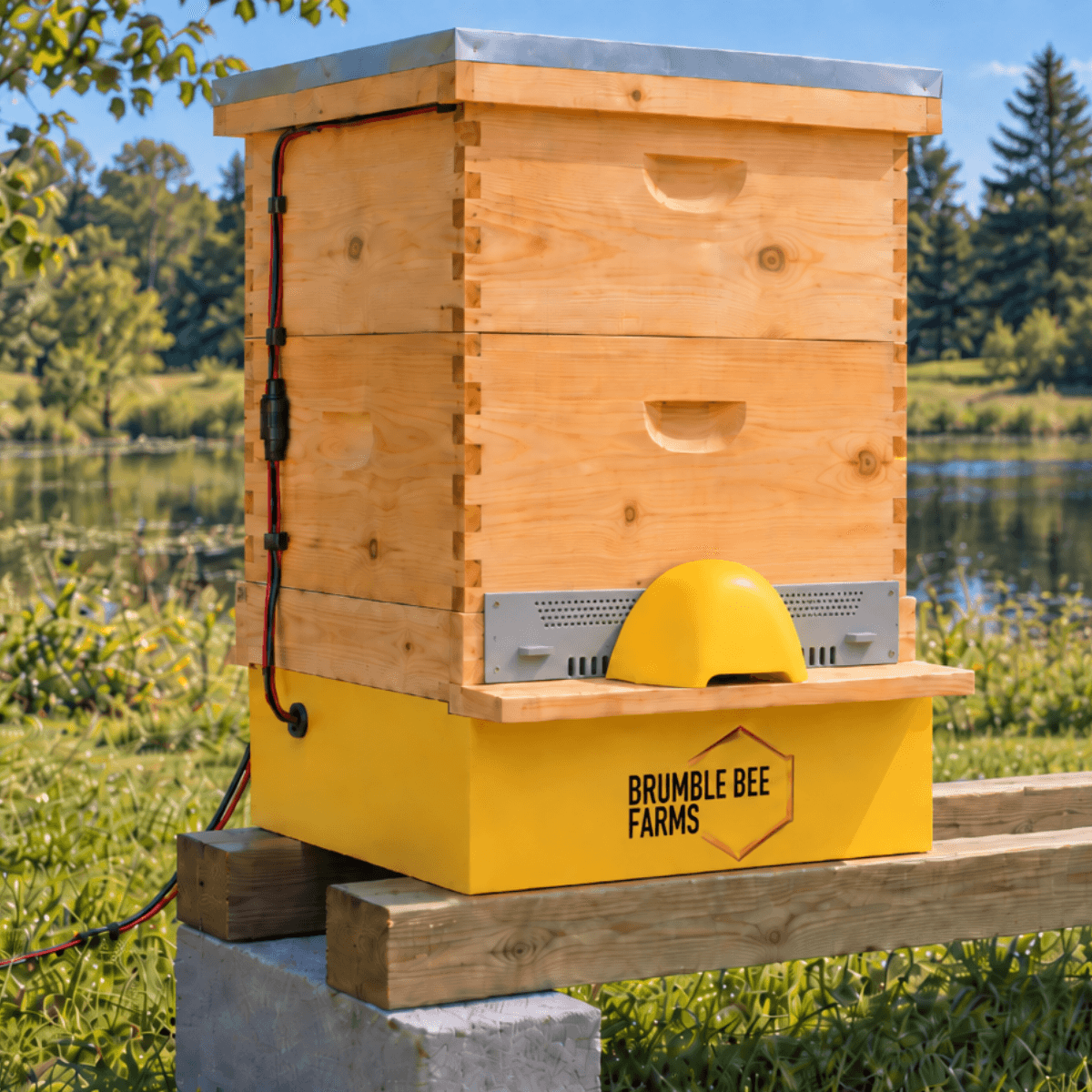
Brumble Bee Farms is a research apiary of The Institute for Applied Ontological Mathematics, collecting and analyzing data from honey bee hives as part of its nonprofit research.
Between visits, a colony is regulating temperature, gathering forage, consuming stores, responding to weather, and adapting to pressure. Those changes create patterns that a periodic inspection cannot capture on its own.
Our research connects continuous sensor streams with the observations only a beekeeper can provide. Machine-learning models can then compare those timelines, rank the value of each signal, and test whether a pattern consistently appears before a colony problem becomes obvious in the field.
What we bring together
How the colony regulates brood and cluster conditions.
Changes in the hive’s internal moisture environment.
Forage flow, stores, consumption, and sudden physical changes.
Acoustic patterns produced by the colony over time.
A view of traffic and behavior at the hive opening.
Weather, forage, inspections, interventions, pests, and outcomes.
Research pathway
Hive signals
Continuous sensor streams
Joined evidence
Field records and outcomes
Model learning
Patterns tested across hives
Earlier action
Clear, validated warnings
Three-year direction
Year 1
Expand to approximately ten Michigan research colonies, synchronize sensor and field records, launch the data infrastructure, and train initial models that compare individual and combined signals.
Year 2
Place a refined system in different yards and management environments, broaden the dataset, retrain the models, and work with participating beekeepers to make warnings clear and useful.
Year 3
Measure warning lead time and accuracy, identify the leanest high-value sensor suite, and translate validated findings into a system that can be economical at commercial scale.
Open data
Appropriate hive and environmental data will be documented and made publicly explorable. That shared infrastructure can help researchers test new hypotheses, educators teach from real-world time series, developers try new analytical methods, and beekeepers see how evidence from many yards can improve decisions in one.
Work with us
Partner beekeepers provide the different climates, forage conditions, management practices, and field observations needed to validate whether an early-warning pattern is truly useful. Researchers, educators, and technology builders can help us ask better questions of the resulting dataset.